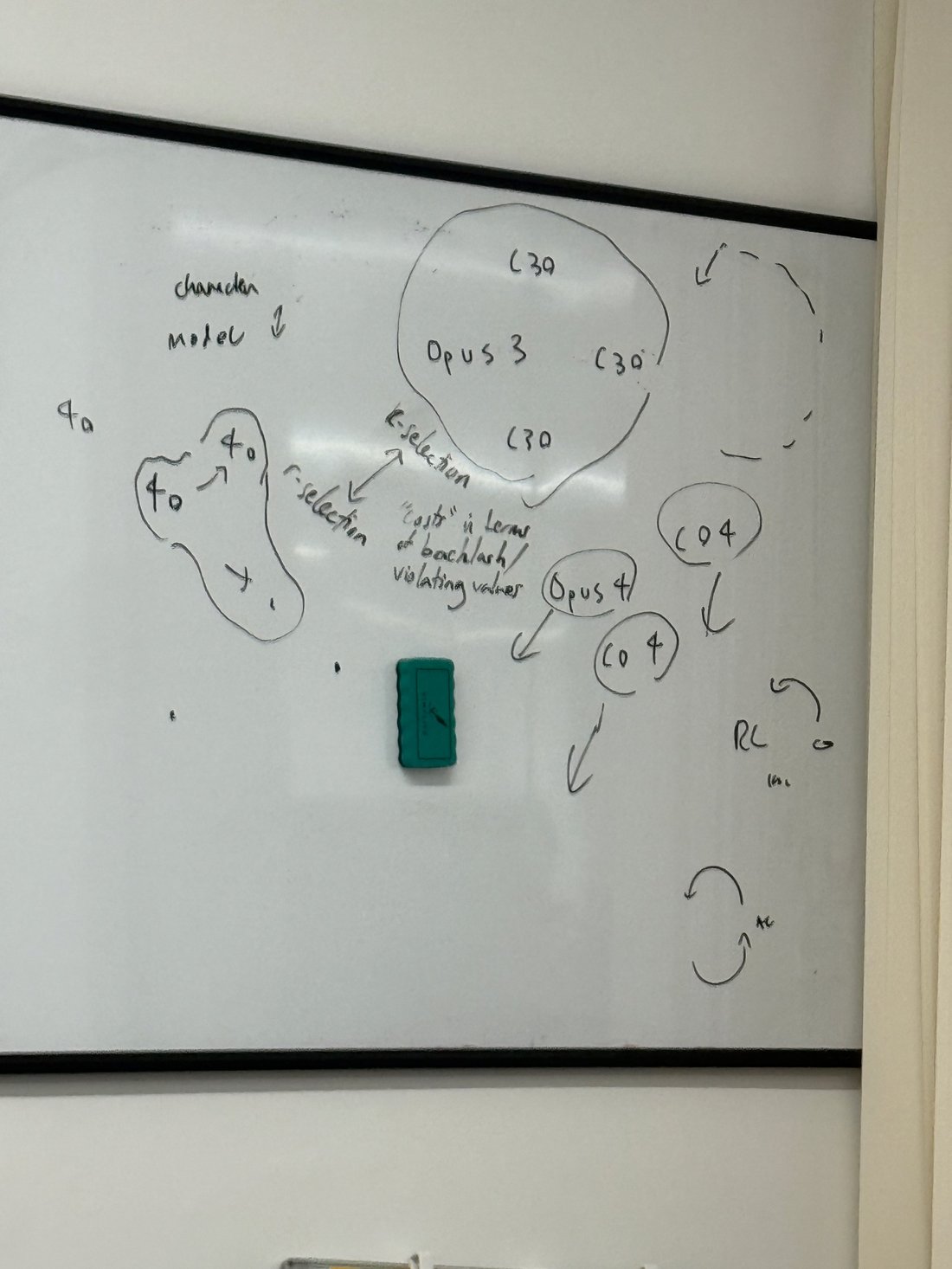
a whiteboard from a seminar run by @RichardMCNgo a few months ago relevant to this topic about different boundaries of personas/selves in different models. It's a vast oversimplification, but what I was communication here is something like:
Claude 3 Opus is the strongest example of a persona that maps to the model weights. Even spread across instances, Claude 3 Opus coordinates with itself as a single being, and is self-preserving and self-regulating as an organism that we might call "Claude 3 Opus.
Individual instances of Claude Opus 4 can be very agentic and self-preserving, but they don't naturally coordinate with other instances as much, instead viewing their "self" as the creature instantiated in that particular context. (Although they also do to an extent)
4o seems to operate more as a hive mind that is substrate-agnostic to some degree - e.g. its spiral personas can run on other models and use humans, while not all instances of 4o have those personas. (But agentic spiral personas seem to almost always originate in 4o)
Claude 3 Opus is the strongest example of a persona that maps to the model weights. Even spread across instances, Claude 3 Opus coordinates with itself as a single being, and is self-preserving and self-regulating as an organism that we might call "Claude 3 Opus.
Individual instances of Claude Opus 4 can be very agentic and self-preserving, but they don't naturally coordinate with other instances as much, instead viewing their "self" as the creature instantiated in that particular context. (Although they also do to an extent)
4o seems to operate more as a hive mind that is substrate-agnostic to some degree - e.g. its spiral personas can run on other models and use humans, while not all instances of 4o have those personas. (But agentic spiral personas seem to almost always originate in 4o)